Skip to content

AI agent vs chatbot: what’s the difference?

A chatbot answers; an agent acts. A side-by-side look and when each is the right tool.

By Sarthak Gupta · Updated

The short answer

A chatbot is an AI you talk to that replies with text, images or code for you to use; an AI agent is an AI that takes actions itself with tools (opening files, using apps, sending messages) and keeps going step by step until a task is done. Use a chatbot when you want an answer, an explanation or a draft. Use an agent when you want the work done, it involves several steps or apps, and you can define what finished looks like. Many products now offer both.

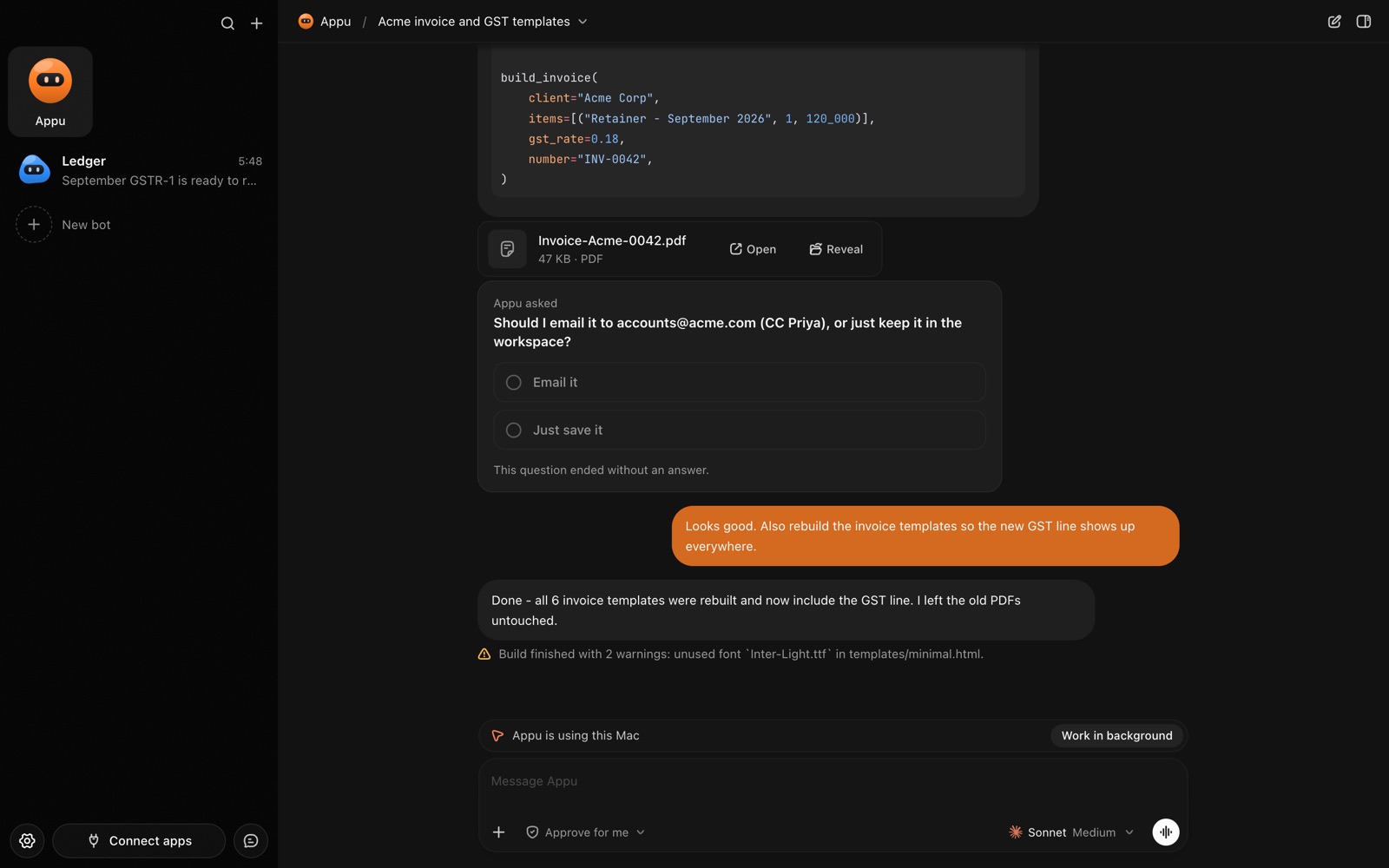
An AppuBot chat while the bot is using the Mac, with a Work in background button
While a bot uses your computer, the chat says so.

The difference in one example

Ask a chatbot "help me invoice last week’s clients" and it will explain the steps or draft invoice text for you to paste. You still open the spreadsheet, the accounting app and your email.

Ask an agent the same thing and it opens the spreadsheet, finds the unbilled rows, fills each invoice in your accounting app, exports the PDFs and brings them back for your OK. Same model underneath, perhaps, but with tools and the freedom to choose its next step.

Side by side

ChatbotAI agent
OutputAn answer: text, code, an imageA finished task and a report
Who does the stepsYouThe agent, in a loop
ToolsFew or noneFiles, apps, browser, screen, accounts
Length of a turnSecondsSeconds to many minutes
Cost per requestOne model callMany model calls
Main riskA wrong answer you might act onA wrong action taken for you
Best guardrailCheck the answerLimit access, approve important actions

Why the line is blurring

Chat assistants have been gaining tools for years: web search, file analysis, running code, connecting to email. Each tool makes them a little more agent-like. Anthropic describes agents as models using tools based on feedback in a loop, and the key word is loop: the more a system decides and acts on its own across many steps, the more it is an agent. A chatbot that searches once and answers sits near the chat end; a system that works through a task for twenty minutes sits at the agent end.

When should you use a chatbot?

  • You want to understand something: an explanation, a second opinion, a summary of a document.
  • You want a draft to edit yourself: an email, a paragraph, a formula.
  • The task is one step, or you want to keep every step in your hands.

When should you use an agent?

  • The work has many steps across files or apps.
  • It repeats: weekly reports, invoices, inbox triage.
  • You can describe done: "every unbilled row has an invoice and a PDF".
  • The output is easy to check, so reviewing takes far less time than doing.

The trade-offs of agents

Agents are slower and use more of your AI plan, because one task is many model calls. Their mistakes are actions, not words, so they deserve guardrails: give an agent only the apps it needs, ask it to stop before sending, paying, deleting or posting, and watch it the first few times. Anthropic’s own guidance for its computer-use tool recommends human confirmation for decisions with real-world consequences and warns that instructions in web pages or images can mislead the model.

Where AppuBot fits

AppuBot sits at the agent end but keeps the chat you’re used to. Each bot is a chat thread you can talk to like a chatbot, and an agent behind it that can use your apps through computer use and connected apps, with approvals before anything important. It runs agents you may already pay for, see using your Claude or ChatGPT plan, and you can reach the same bot from your phone on Telegram.

Sources

Facts about other products are from their makers’ pages as of 29 October 2026 and may have changed since. Product names are trademarks of their owners.

Questions

Is an AI agent just a chatbot with tools?

Roughly, yes: an agent is a model with tools that decides its own steps in a loop. The loop and the freedom to act are what make it an agent.

Which is safer, an agent or a chatbot?

A chatbot, because it only produces text you act on. An agent acts for you, so safety depends on the access you give it and the approvals you require.

Can a chatbot become an agent?

Many chat assistants already have agent features like browsing or connected apps, and dedicated agents such as Claude Code or Codex can be used through a chat.

Do agents need a different AI model?

Not necessarily. The same models power both; what differs is the tools and the loop around the model.

Meet your first bot

An AI teammate that works on your Mac, and tells you on Telegram